A short record of research and shipped industry work. Personal builds are listed at the end.
Divertor digital twins
University of York · Plasma Science & Fusion Energy · Oct 2023 – present (expected 2027) Digital Twin Model Development for the Divertor in Fusion Power Plants
The divertor is the tokamak’s heat-exhaust component. It has to survive high loads over a plant lifetime. A digital twin is only useful if measurements actually constrain it, and if that reconstructed state can support through-life decisions rather than a snapshot of the present.
I treat that as three related problems: diagnostic design (how to instrument a plasma-facing component); reconstruction of fields from sparse sensors; and prognostics and health management. A designer emits machine-readable diagnostic configurations rather than leaving that step in a notebook. During my secondment at digiLab (Mar–May 2025) I applied this to divertor heat-flux data for NSTX-U and MAST-U plasma-facing components.
A first-author review in IEEE Access (2025); an IAEA oral on diagnostic design for divertor heat loads (October 2025); an IAEA poster on the Diagnostic Designer (May 2026); a diagnostic-layout preprint on SSRN (submitted).
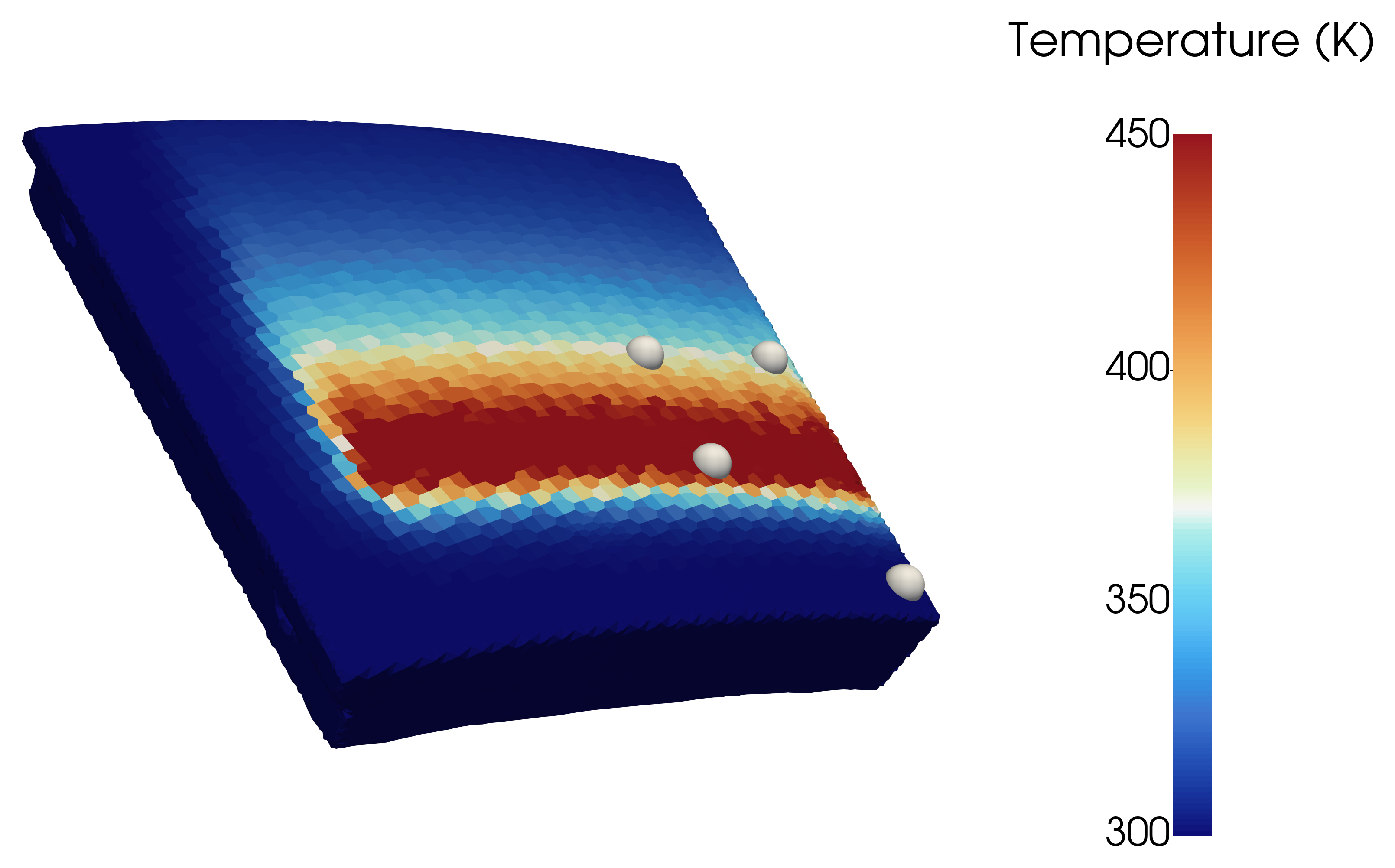
Example BED thermocouple layout on a divertor tile temperature field (K). The markers are candidate sensor sites.
Assystem: nuclear data / digital
Data Scientist (Data / Digital Engineering) · Blackburn · Sep 2022 – Jan 2024
Nuclear and engineering programmes accumulate more operational and design data than teams can easily use under assurance constraints.
I led multi-client digital data-services work: analytics and data-platform workflows, plus an AI-in-fusion feasibility study (data integration and predictive modelling) that informed a tender bid.
Cut manual reporting; internal estimate of about £110k a year in avoided admin cost. The fusion feasibility work informed a £2M+ tender.
Data Analyst (Medical Imaging / Auto-Contouring) · Oxford · Oct 2020 – Aug 2022
Manual organ-at-risk contouring for radiotherapy planning is slow and varies between observers.
I built production deep-learning auto-contouring pipelines for organs-at-risk in neuro-oncology, as part of Mirada’s DLCExpert product line.
Pipelines used in a shipped clinical product: more than 90% of contours usable, with planning time moving from hours toward minutes. Co-author on the 2023 Physica Medica EPTN atlas evaluation; that paper reports brainstem vDSC 0.92 / sDSC 0.84 and clinically acceptable dose (∆D within ±1 Gy for 92% of 26 OARs).
divertor-diagnostic-designer GitHub. Python toolkit for synthetic divertor diagnostics and thermocouple configurations, including HEAT-based heat-flux inputs.